
The Best Guide to Building a Resume
Planning to build a resume and apply for a job? Read the complete A to Z of resume writing here so you can build a professional resume. This is the most complete and thorough resume guide in the galaxy!
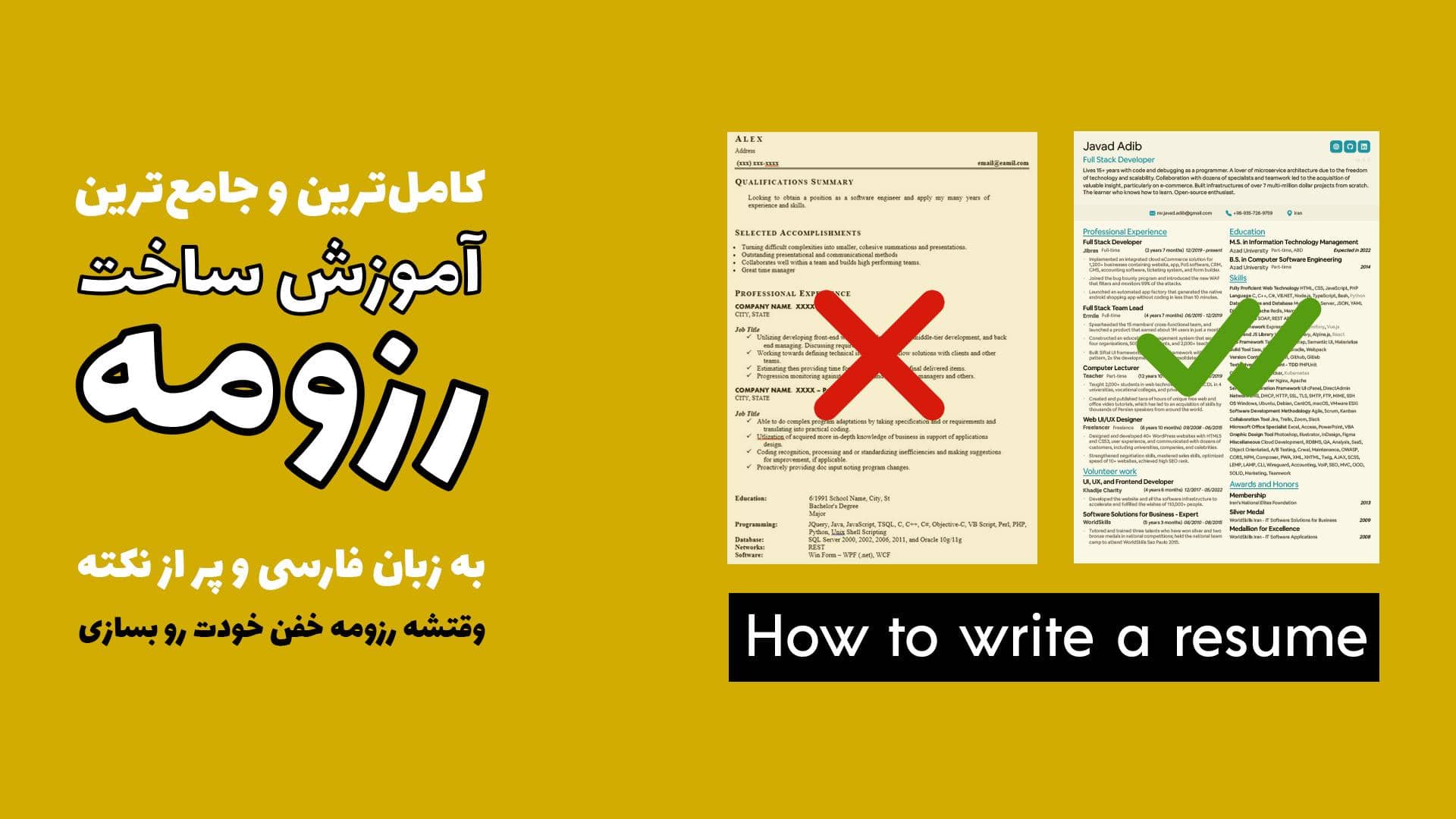
A good resume is your way into a dream job. If your resume is weak, you might wait weeks or even months for an interview invite and a first reply. So when you can have a strong resume, why not? Put in a little time and make your resume professional, and you will see how much your interview rate goes up.
So you are probably asking yourself how to write a standout resume that pulls in recruiters, HR, and hiring managers and makes them want to invite you to an interview. You have come to the right place!
In this guide I have gathered every tip about resumes I could find from trusted sources, to show you how to build that standout resume of yours and land a great offer with it :)
A step-by-step guide to building a resume
When we break a big job into small pieces, it turns out to be far easier to get done. So let us see how to move forward step by step.
Next we go through the different sections of a resume in order. We explain what to write and how to write it so you stand out and reach the job you deserve.
Table of Contents
Resume template
Types of resume structure
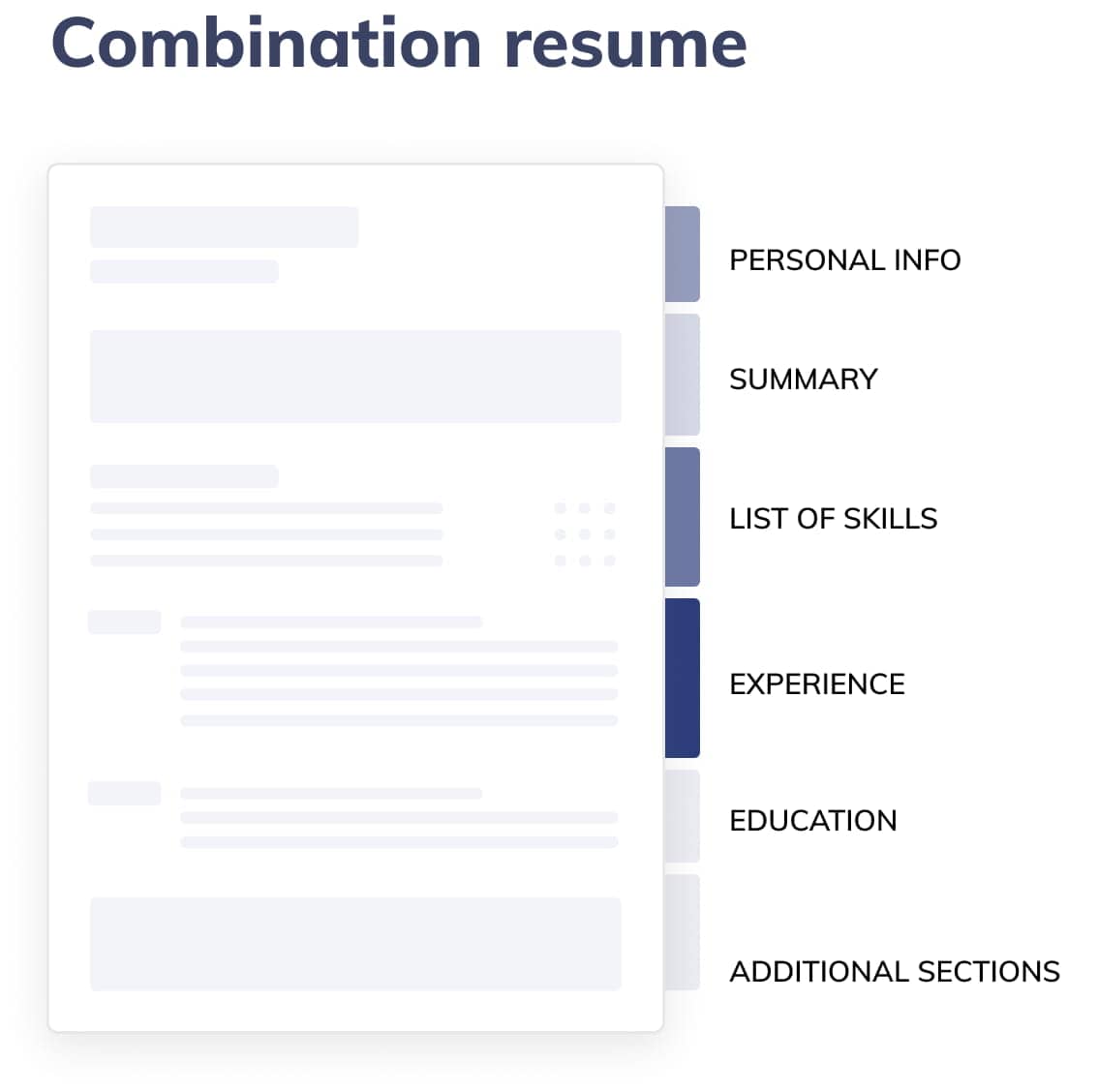
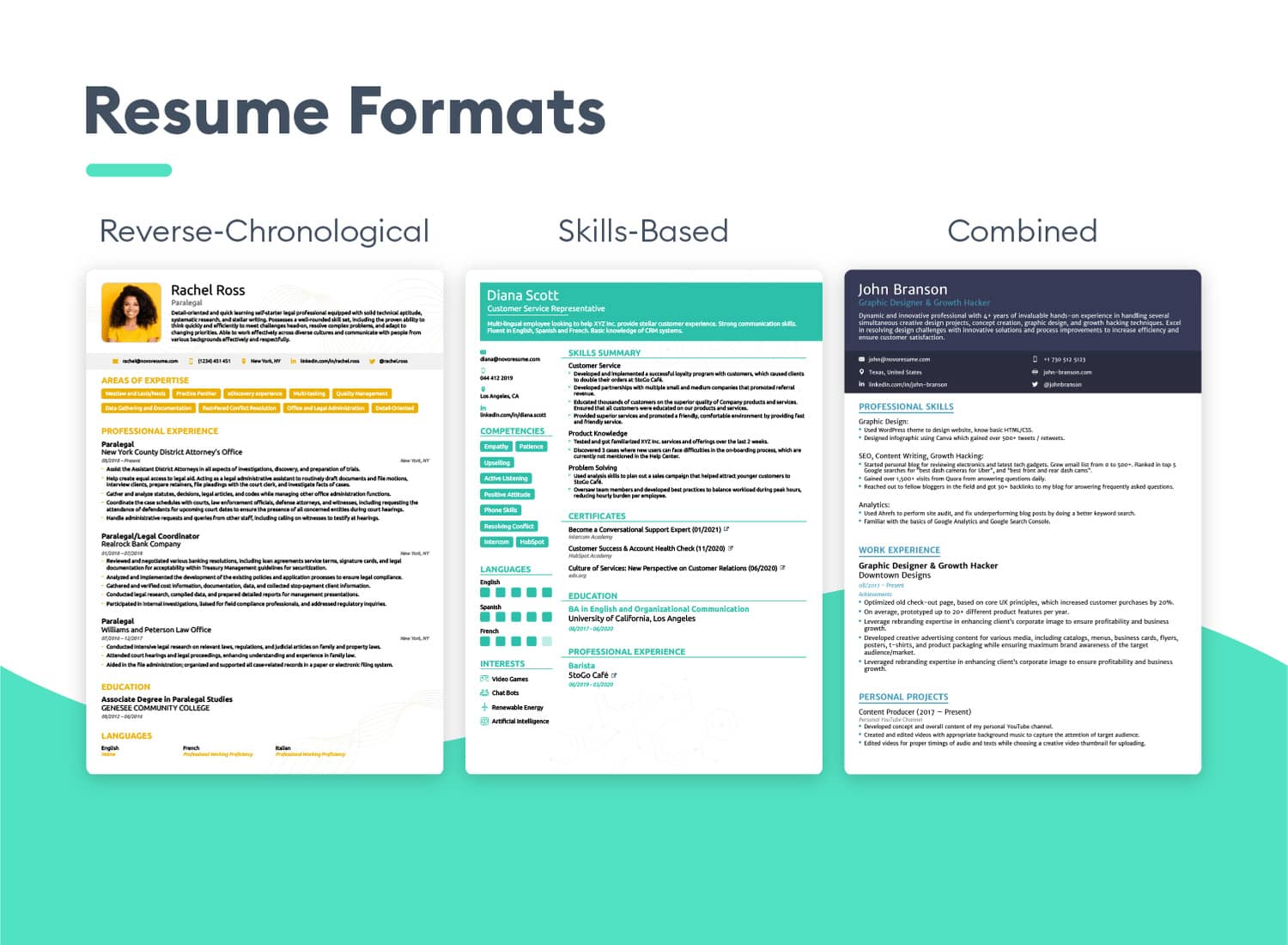
There are three different resume structures, and you can see them in the figure below. They differ in which section they emphasize and how the sections are ordered. The difference between these structures is the arrangement of the resume's sections. For now we are not concerned at all with the graphic design of each section.
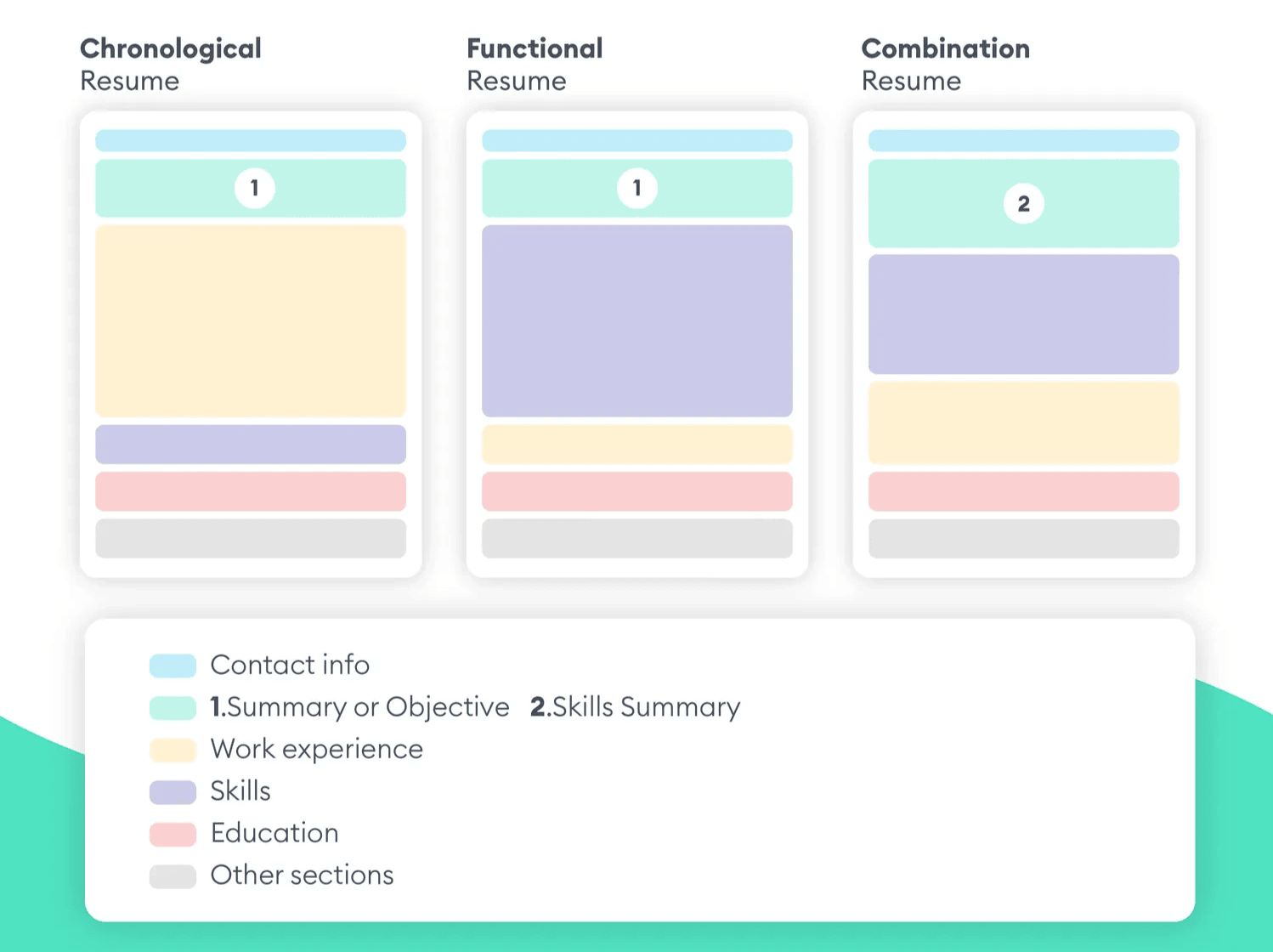
We will build each section together in detail. On this page, just focus on choosing your own resume structure.
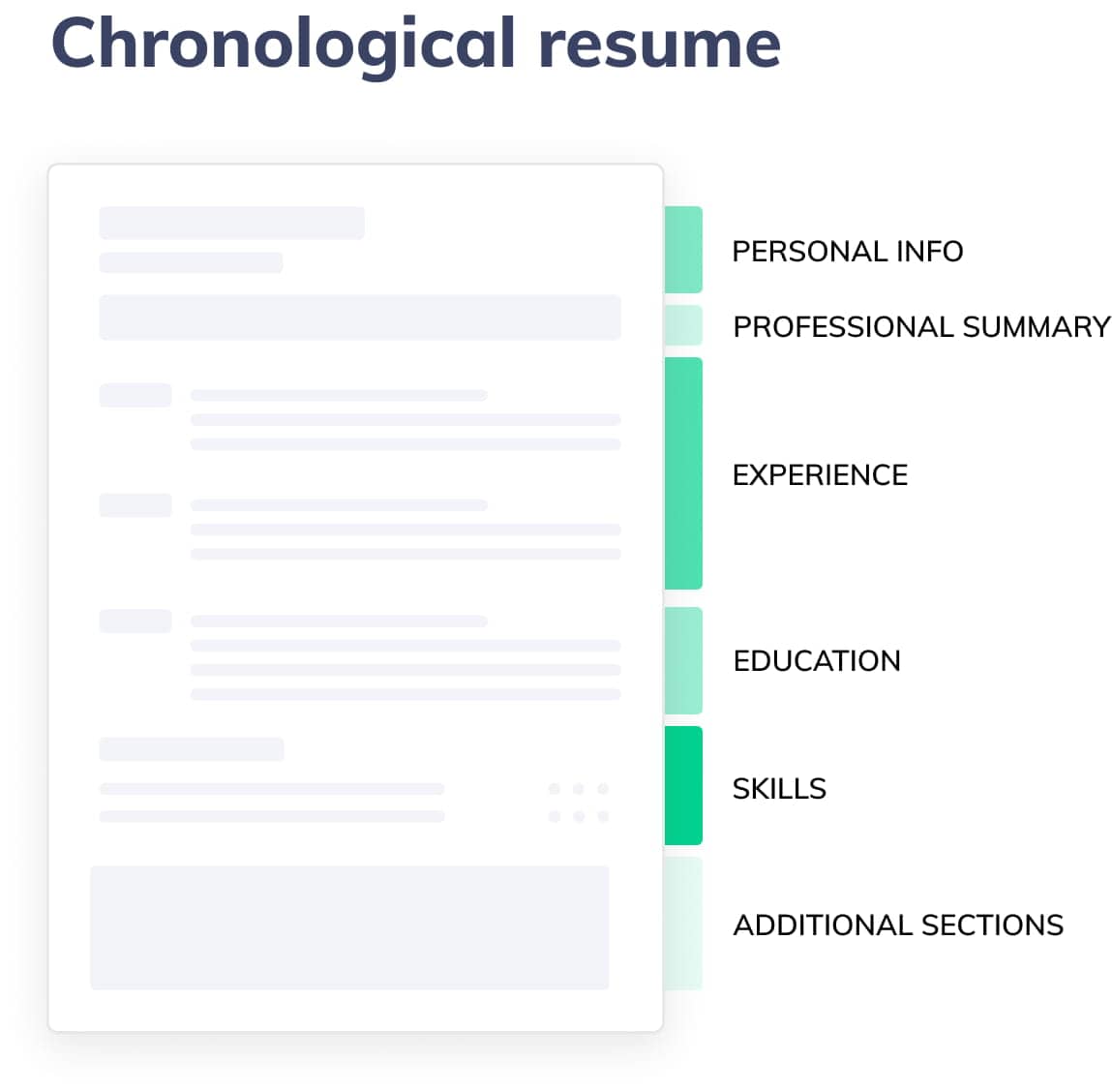
Chronological resume format
This is the most popular work resume format and it is ideal for people who have plenty of work experience relevant to the job they are applying for. Your most recent job is listed first, and you list the rest going back in chronological order.
Recruiters know this format inside out and know exactly where to look for the information they want.
If you have little work history, filling almost half a page with a work experience section will be hard, and it may be better to choose one of the functional or combination formats.
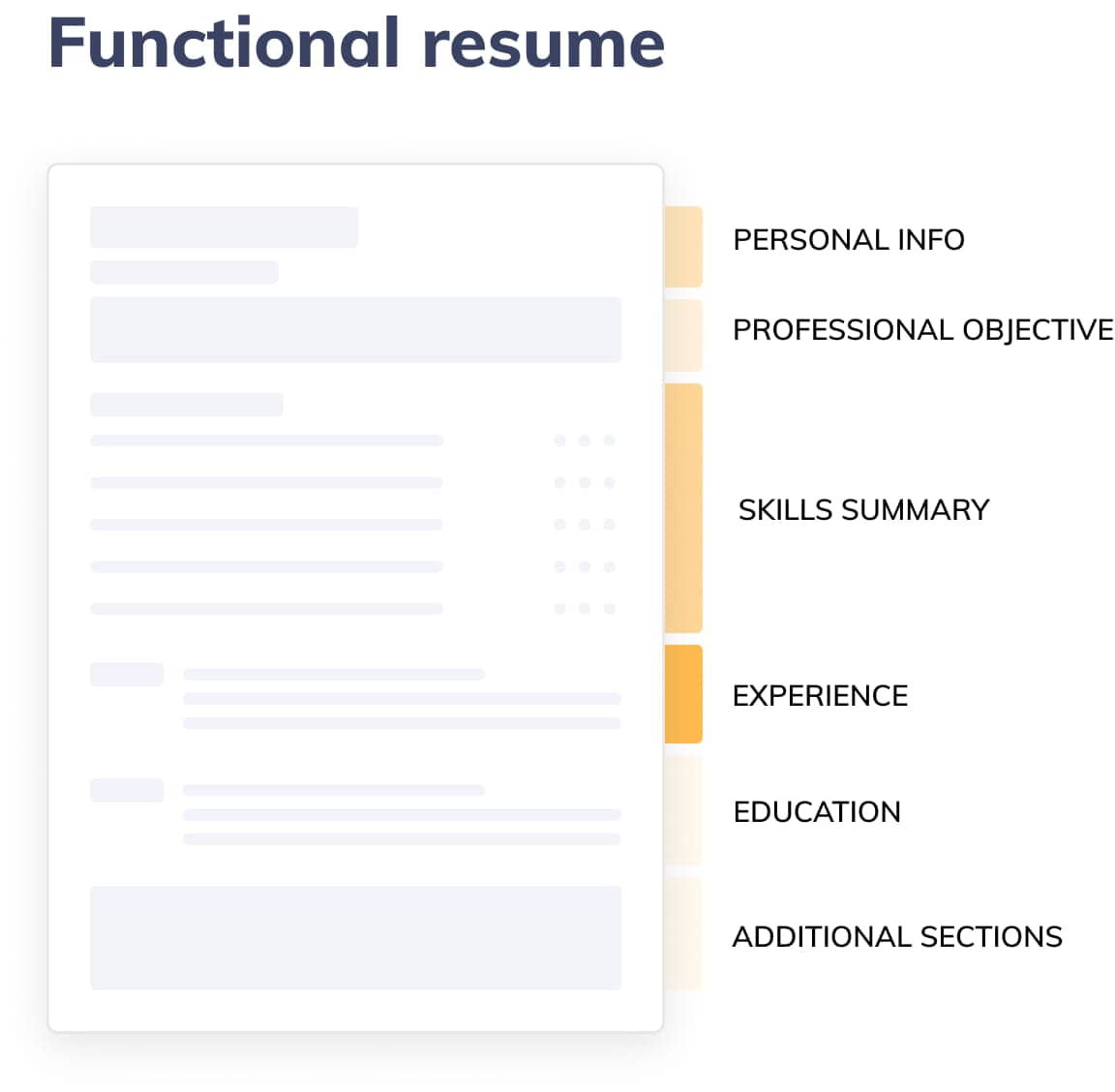
Functional resume format
If you are a student, a recent graduate with no work experience, or you are looking to change careers, this format may be a better choice for you. For example, you might have a long gap in your work history, or you might want to try a new line of work after several years.
In the functional resume structure, the main emphasis is on your skills, and work experience is mentioned briefly.
Combination resume format
The combination format is a good choice for people with a diverse set of skills. If you are applying for a job that needs expertise across several areas, it can work well for you.
The combination, or hybrid, resume structure emphasizes work history and skills at the same time.
Choosing the right software or service to build your resume
After choosing a structure and before you start writing your resume, you need to decide which tool you want to build it with. There are many ways to build a resume, from Microsoft Word and other text editors, to sites built for creating resumes, to Overleaf and HTML and CSS.
It makes no difference whether you want to build a Persian or an English resume. Either way you need to choose the right software for building your academic or work resume. Plenty of sample work resumes are available through the links below.
If you prefer to use Microsoft Word, you can visit the address below, download a free Word template, and edit it offline on your own machine. View a blank resume file and a sample resume in Word format through the link below, and pick one to download the blank resume.
If you prefer to use Overleaf, the link below is a standard resume template and comes recommended.
- https://www.overleaf.com/latex/templates/tagged/cv
- https://www.overleaf.com/latex/templates/data-science-tech-resume-template/zcdmpfxrzjhv
Plain text editors are very popular, but the problem is that you can lose hours on the design. You make one small change and boom, the whole resume falls apart and you have to spend a lot of time fixing it. This is exactly the pitch that resume builder sites make when they claim they can build your resume fast. You have plenty of options for building a resume online with a free online resume builder, some of them even in Persian.
What is the best layout for a resume?
The first thing a recruiter notices is the resume's layout. Does it look messy and cluttered, or organized and clean? Is it too short or too long?
The do's of resume layout and design
Let's go over a few of the best practices for resume layout together.
How many pages should a resume be? One page
If you truly believe you can add significant value, go to two pages. HR managers at large companies see more than a thousand resumes a month. Rest assured they will not spend their valuable time reading your life story. The statistics say you have 6 seconds, or they move on to the next one.
Why do you say a resume should be one page?
Use a consistent design
Set a specific size for your headings and use it the same way across all sections.
Enough white space
Leave enough white space, especially in the margins around the page.
Choose a readable font
We recommend choosing a formal, readable font such as Ubuntu, Roboto, or Overpass, and never even testing something like Comic Sans. One font is certainly enough for a resume, so do not clutter it.
Choose a suitable font size
As a general rule, use size 11 to 12 for body text and size 14 to 16 for headings.
PDF and nothing else
You should only use the PDF version. Word and other formats are for you, so that you can edit. Everyone else is only going to read. So PDF only.
Keep the PDF size small
We strongly recommend never letting your resume file exceed one megabyte. If you can, keep it under half a megabyte. If you can, under 200 kilobytes. Going lower gets hard. Images and special fonts can push the size unusually high. Some places accept up to 5 megabytes, but when you can reduce the size, do it.
Naming your resume file
Imagine a recruiter has downloaded your resume file and it is named myresume.pdf. Isn't it better to spend a few seconds and fix the file name? Use your name, a dash, the word resume and, if you like, a version number, so you know which file is the latest after each edit. For example, this is how I name mine. Do not forget that a resume is different from a CV.
MrAdib-Resume-v123.pdf
Consistency
Please stick to one approach. For example, use a fixed format for dates in your resume. Do not separate the numbers with a dot one time and a slash the next.
Traditional or creative resume template?
Now that we have covered the main points, there is one thing we may need to talk about, and that is whether to use traditional templates or creative, modern ones. Take a close look at the image below.
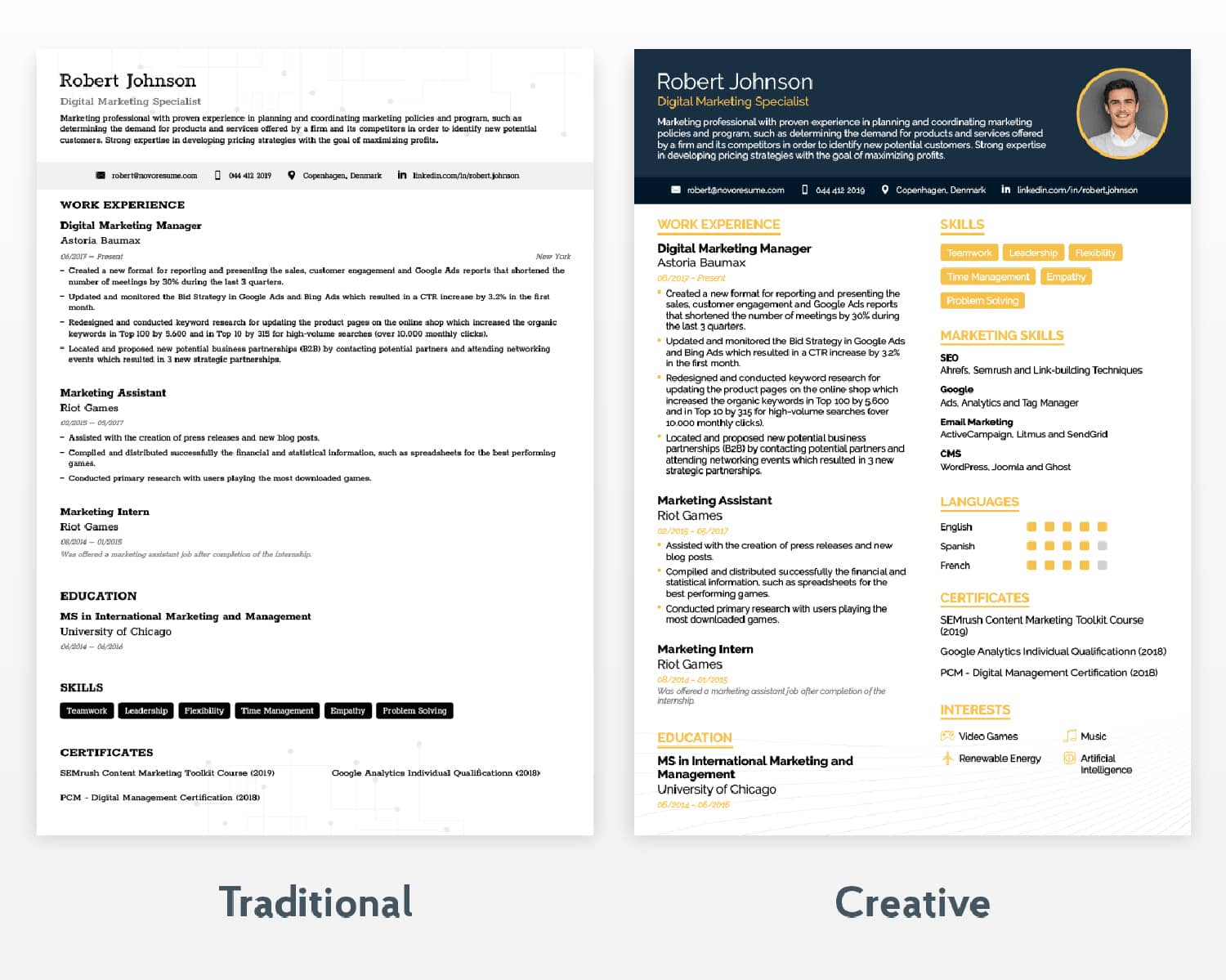
A creative or visually designed template can make sense when your work is about design or visual craft. A designer may want to signal creativity and innovation. A bold layout can do that. Even then it is optional and up to you.
For most other fields, a clean traditional template is the safer choice. This is a personal choice that depends on your field and the impression you want, not a rule. Remember, more creativity means more risk.
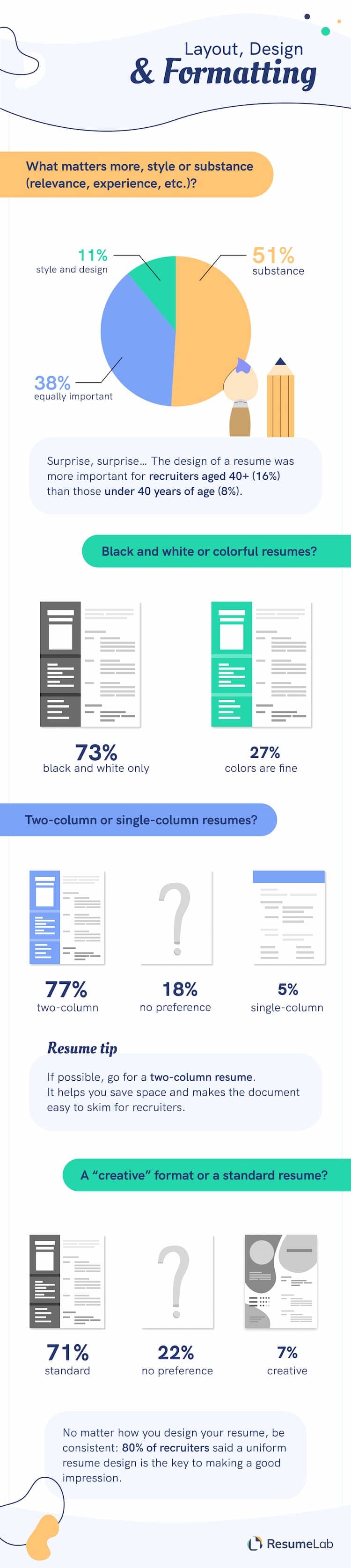
Infographic on resume layout rules
This section's checklist
0/6Contact information on a resume
Imagine you have a wonderful resume that wins over everyone who reads it. If the recruiter cannot find a good way to reach you, what was all that effort for? Contact information is a vital part of your resume.
The essentials in the contact section
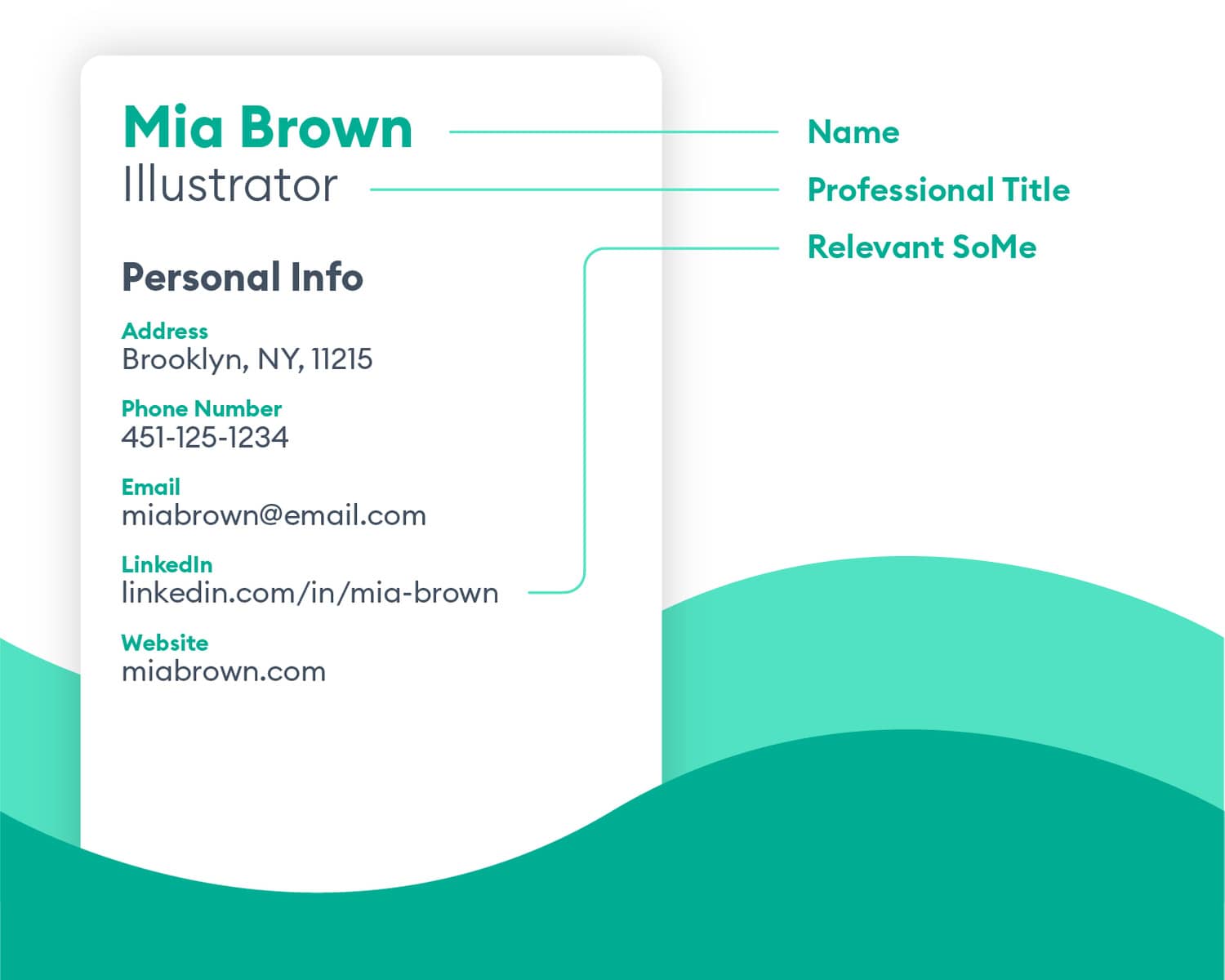
Full name
It sounds simple!
Job title
Your professional title can be your current role or the job you are aiming for. For example, Senior Software Engineer or Data Analyst. One important point here: skip strange titles like ninja or samurai. Try to keep it under four words.
Email address
Very important. Almost everything happens through this email.
Phone number
Recruiters and hiring managers call you directly, often before any message and sometimes just from finding your CV. So your phone number genuinely matters. Make sure it is correct and reachable.
Location
This means your current city and country, so the company can tell whether you would need to relocate.
If you are applying in the same country you live in, the city matters, so include it. If you are applying from another country and would relocate, the city name means nothing to them, so mention just the country, not the city.
Optional details in the contact section
When you add optional items, make sure they add real value to your resume.
LinkedIn profile
If you have an up-to-date profile that can raise the value of your resume, it is a good idea to add it.
Social networks
Do you publish your work online? For developers this could be a GitHub address, for designers it could be Dribbble.
Do not put social media links in a CV. No Instagram, no Twitter or X. They add no value. The only links worth including are GitHub, Dribbble, or a graphical portfolio website relevant to your work. This holds for both Persian and English CVs.
Personal website
If you have a personal website or a blog where you write about your field, it is good to add it to your resume. Likewise, if you do graphic work and have a portfolio, it is good to include the link.
The site must be high quality. Linking to a low-quality or unfinished site is a negative, not a positive. Only link it if it genuinely showcases good work.
What to avoid in the contact section
Please make sure you have not put these items on your resume.
Date of birth
A recruiter or HR does not need to know how old you are. Age is not relevant to the decision. Worse, it can lead to age discrimination. If a company truly needs it, they will ask for it separately in a form, so do not insist on putting it on your resume.
Unprofessional email address
Use a simple email with your first and last name on a common provider like Gmail so you never miss a message, for example [email protected], and please do not use odd addresses like [email protected].
Photo
A recruiter does not need to know what you look like to evaluate your resume, so do not add your photo. It invites a snap judgment. They will see you soon enough in the interview or on your LinkedIn profile picture.
This is part of your privacy. Of course, if you want to add a photo, no one can stop you, but keep in mind it might cause an automated ATS to reject you.
Your home address!
It is strange how often I see a full home address on some resumes. No one is going to mail you a letter, so no one needs it.
Other unprofessional details
If you have listed any of the following on your resume, please remove them.
- Gender
- Military service status
- Marital status
- Number of children
- Physical health status
This all seemed clear. Read this section out loud to yourself once and make sure no mistake slipped in.
Examples of the contact section
A successful contact section, design aside, can look like the images below.


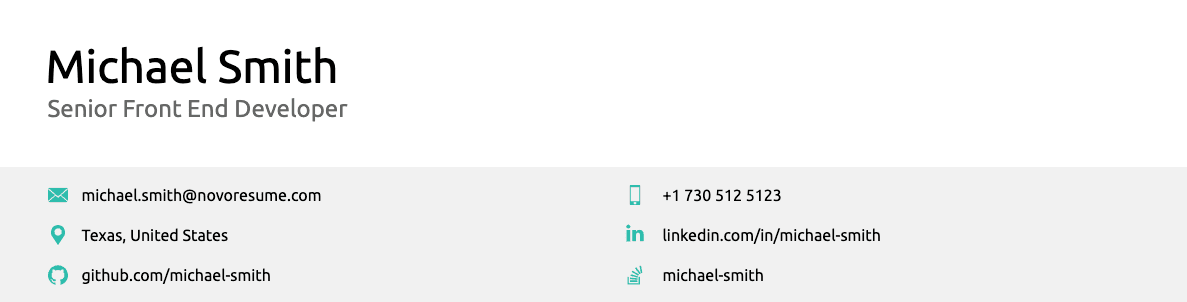
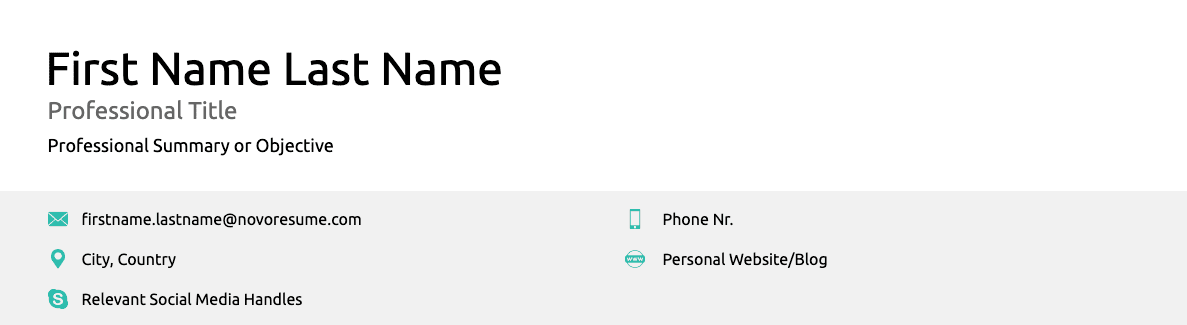

Check twice, three times, even ten times that you listed everything correctly, and more importantly, keep this information up to date.
This section's checklist
0/6The summary section on a resume
If the first impression is a bad one, it usually sticks and is hard to change. So let's not waste the chance, and win the reader over with the best summary we can.
According to the numbers, recruiters spend about 6 seconds scanning each resume. Yes, all that effort for 6 seconds. They only spend more time if their attention is caught. One of the key sections that can catch it is the resume summary or objective, which sits next to the contact information.
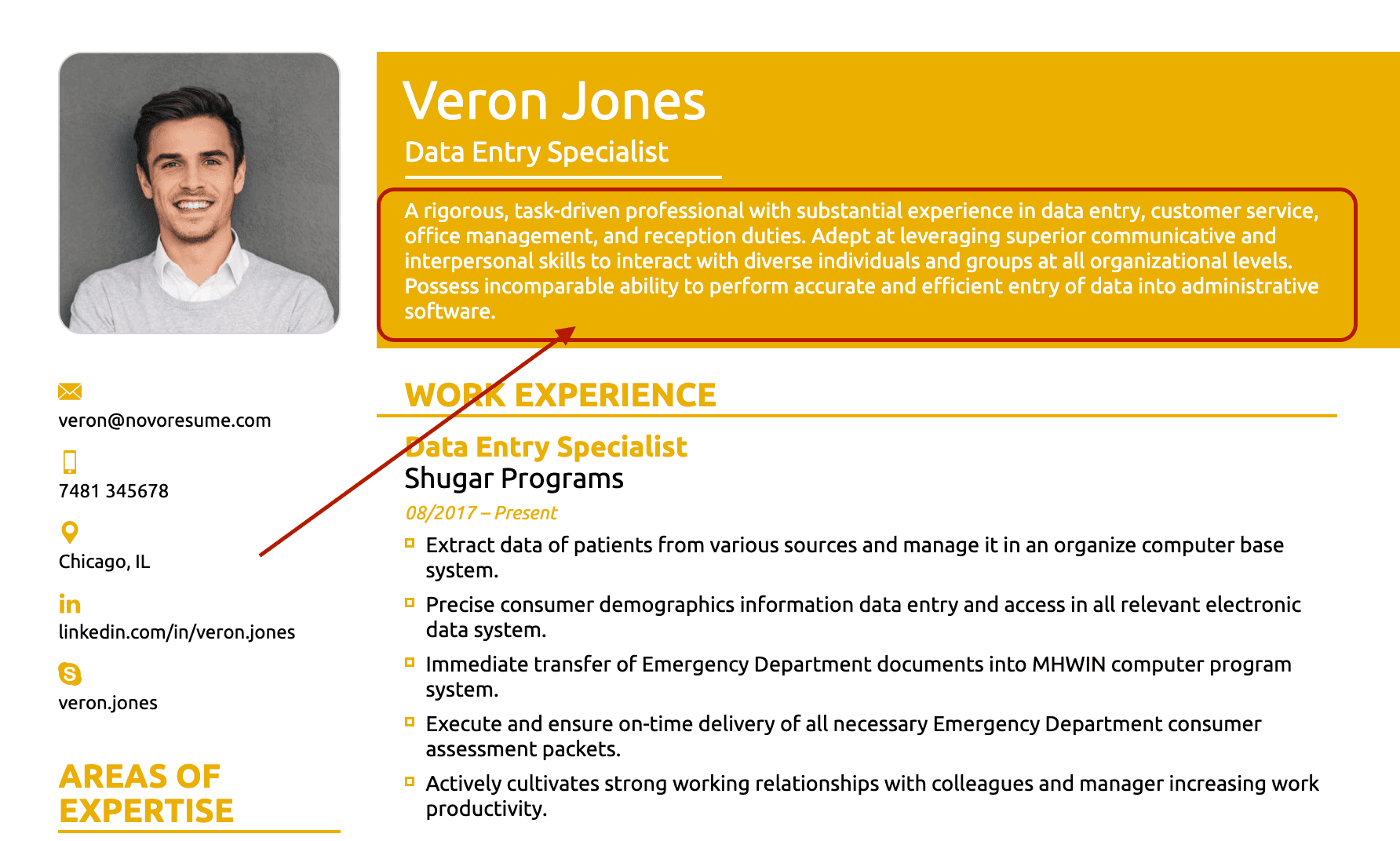
What is a resume summary and when should you use it?
A summary is usually 2 to 3 sentences about your job. Using a resume summary is recommended, though it is not mandatory.
In the resume summary, it is best to mention the three things below.
- Your current job and years of experience
Customer support representative with 5+ years of experience in the IT industry. - One or two of your main achievements or responsibilities
Specialized in technical support, customer care, and user retention. - Your motivation or the goal you expect from the work
Looking for new opportunities as a support lead for a SaaS company.
The resume objective
In some cases, this section is called the resume objective instead. It refers to when you are planning to change your field of work, or you have just graduated and do not have much work history, and you mostly want to talk about your interests.
A formula for building a resume objective can look like this.
- A skill, education, or certifications related to the job title
- Seeking x months or years of a certain kind of experience in a certain job title at a certain company
- To help the company by taking on responsibilities you can deliver successfully
For example, if you are a student, you can follow this template.
Hard-working recent graduate with a B.A. in Graphic Design from New York State University seeking new opportunities. 3+ years of practical experience working with Adobe Illustrator and Photoshop, creating illustrations & designing UX / UI. Looking to grow as a designer, as well as perfect my art, at the XYZ Design Studio.Or, for example, if you plan to change your job title, you can write it like this.
IT project manager with 5+ years of experience in software development. Managed a team of developers to create products for several industries, such as FinTech and HR tech. Looking to leverage my experience in managing outsourced products as a Product Owner at XYZ.This section's checklist
0/2The work experience section of your resume
If you master just this one section of the resume, you can say you have learned 80 percent of resume writing.
There are plenty of techniques and rules to follow when writing your work experience. Let us start by going over the basics together.
How to list your work experience on a resume
The standard format for a work experience entry includes the following.
- Job title / position
- Company name / location / description
- Dates of employment
- Achievements and responsibilities
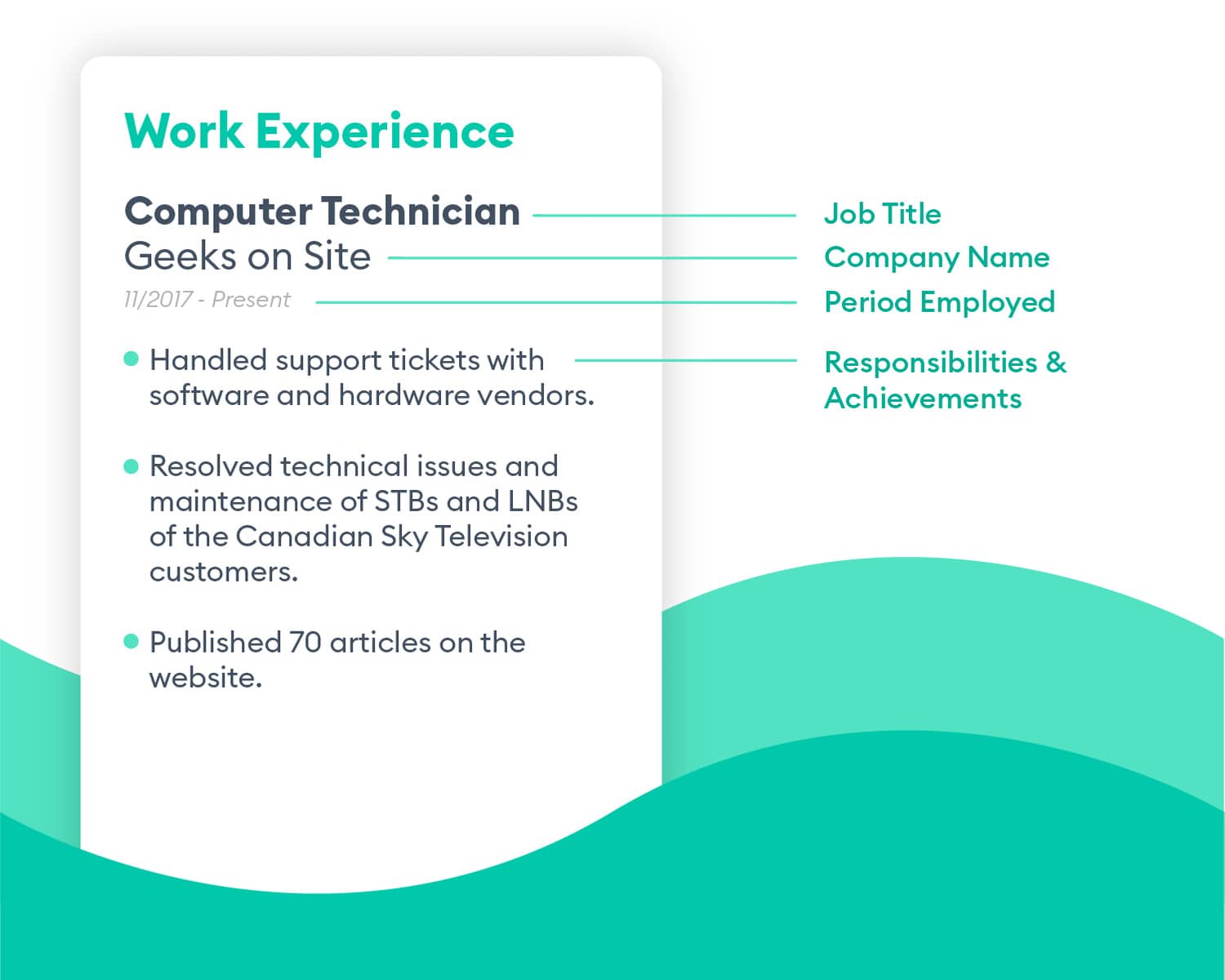
Job title
Always write the job title first. When a recruiter scans your resume, they want to see at a glance whether you have relevant experience, so make its font larger than the rest or use a different color.
The titles of your previous jobs should be clear. Keep it simple and write whatever was in the job posting, because it can also matter for the ATS.
Company name, description, and location
Next, give the employer and company name, and mention the location, meaning the country and city. If the company is not well known, introduce it briefly in a sentence or two, no more than a line.
You can also state the type of employment in a single word, whether it was full-time, part-time, contract, and so on.
Full-time, Part-time, Contract, etc.Dates of employment
The period you were employed at the company, meaning the year and month you joined and left. For your most recent job, instead of a date you can write the word present, meaning up to now.
The standard date format on a resume is mm/yyyy. So, for example, for the third month of 2017 you write it like this. 03/2017
Pay attention to each job's dates. Under normal circumstances it makes no sense to hold two full-time jobs at the same time.
Also write how long you were at that job, so no one needs to calculate the difference between two dates. For example.
(2 years 7 months) 12/2019 - presentA gap between two jobs is a red flag only if there is no explanation for it. When HR sees a gap, they assume the worst scenario, so it is better to have a good and honest explanation ready. For example.
July 2018 - February 2019, due to my medical situation, I had to take time off to fully recover and focus on my health.Of course, you do not need to tell the whole story, especially when the reason is personal. But be ready to explain it briefly in the interview.
Achievements or responsibilities
This part is the core of every work experience entry. Depending on your field, you can list your achievements or your responsibilities, which we will look at more closely below.
Write about your achievements whenever you can.
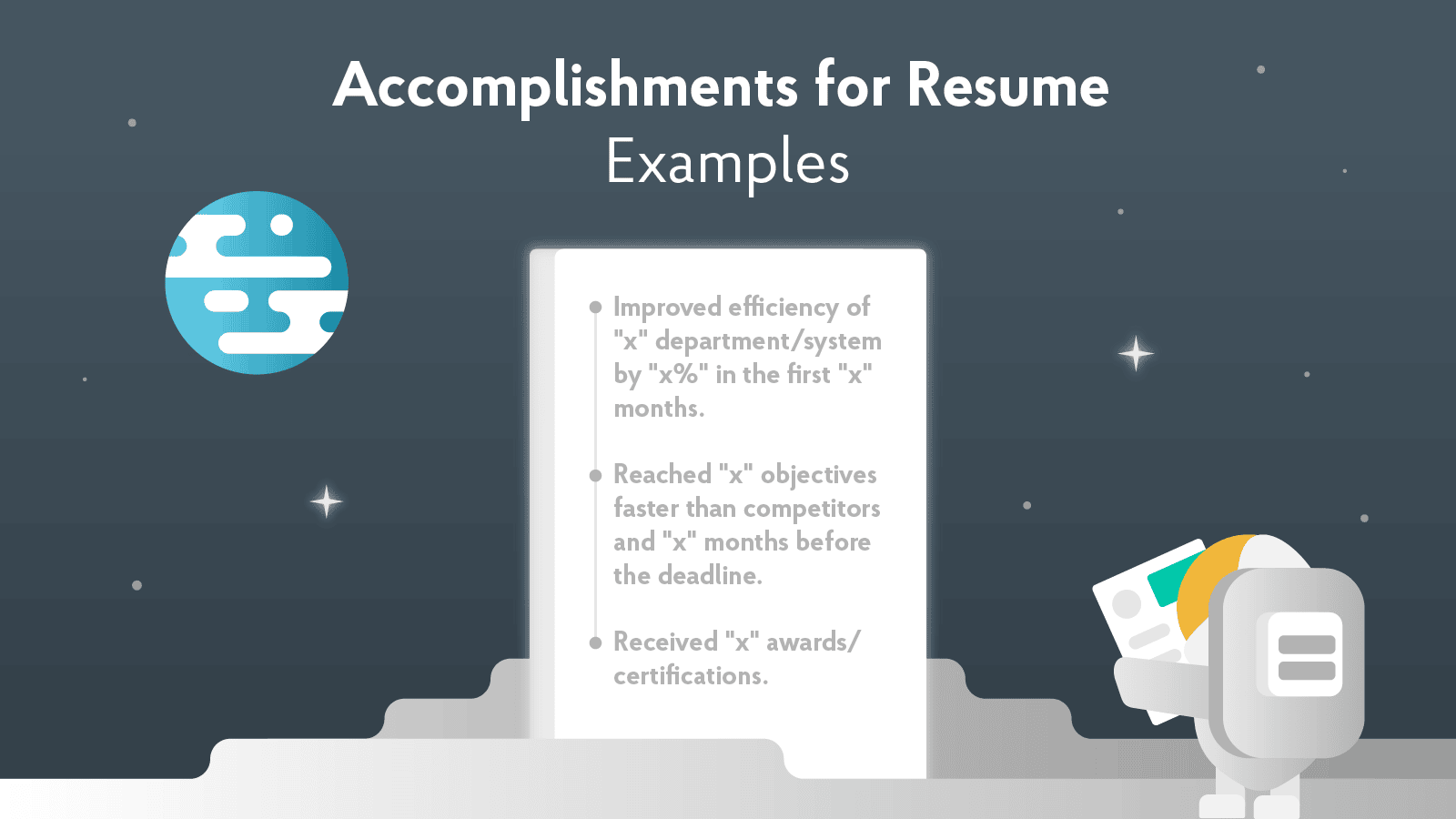
One of the common resume mistakes is listing only responsibilities. In most cases, the recruiter already knows the scope of your duties. Let us work through an example. Suppose you are a sales manager. Your responsibilities are probably these.
- Reaching out to potential customers by phone and email
- Maintaining relationships with existing customers and selling company products
- Tracking and reporting from the customer management system
As it happens, this is a list of the responsibilities of any sales manager. 90 percent of resumes probably mention these points.
So, to make your resume stand out, focus on achievements instead of responsibilities. Put simply, what exactly was your role in the company's growth? If you can, use numbers to say what changes you made and how much of an impact you had. For example, let us look at two good samples.
Exceeded sales team KPIs by 30%+ for 3 months straight.Generated over $24,000 in sales in 1 month.Keep in mind that in some fields there are not many achievements to point to, and finding numbers will be genuinely hard. In those cases there is really no other choice, and listing responsibilities is the alternative.
Reviewing a work experience example
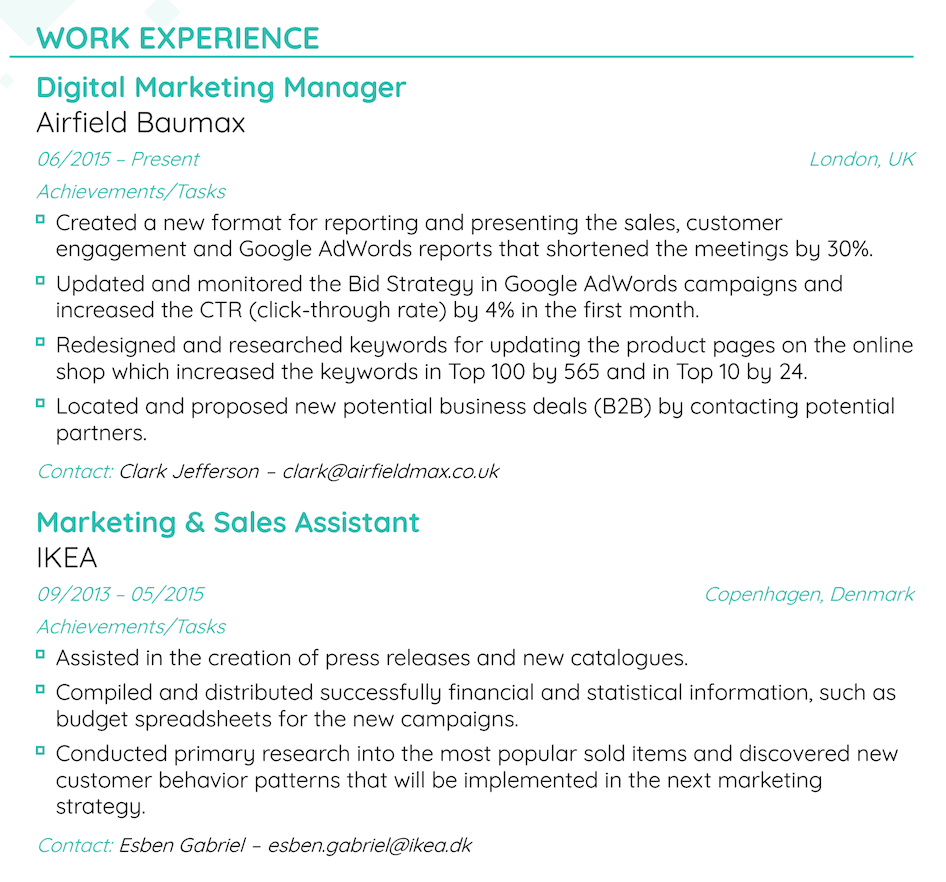
How much work experience should you put on a resume?
If you have more than a decade of valuable work experience, you are probably confused about how much of it to put on your resume. If you tried to list every job you have held, you would practically be writing a novel. On the other hand, if you are just starting out, you probably have no experience and do not know what to write.
The amount of information you include on your resume will differ depending on your level.
No work experience
If you have no experience, filling this section is definitely hard. You can leave this section empty and focus on the other sections, or fill it with experience from student, non-profit, and charity organizations, and so on.
Entry-level candidate
List every job you have done so far.
Mid-level professional
Write only the work experience relevant to the job title.
Senior professional
List at most 15 years of work history. If your recent experience was as a CEO, no one cares that you were a cashier as a teenager.
This section's checklist
0/8The right verbs for your resume achievements
When you write your resume and describe your achievements, it helps to start each sentence with an action verb. The list below is a set of strong verbs put together by hiring managers at large companies, ready to use in your resume.
How to write your achievements on a resume
There are two patterns you can use to write each achievement bullet on your resume.
Notice how you should begin with an action verb. Then describe the task or project briefly, and close the sentence with the impact you had.
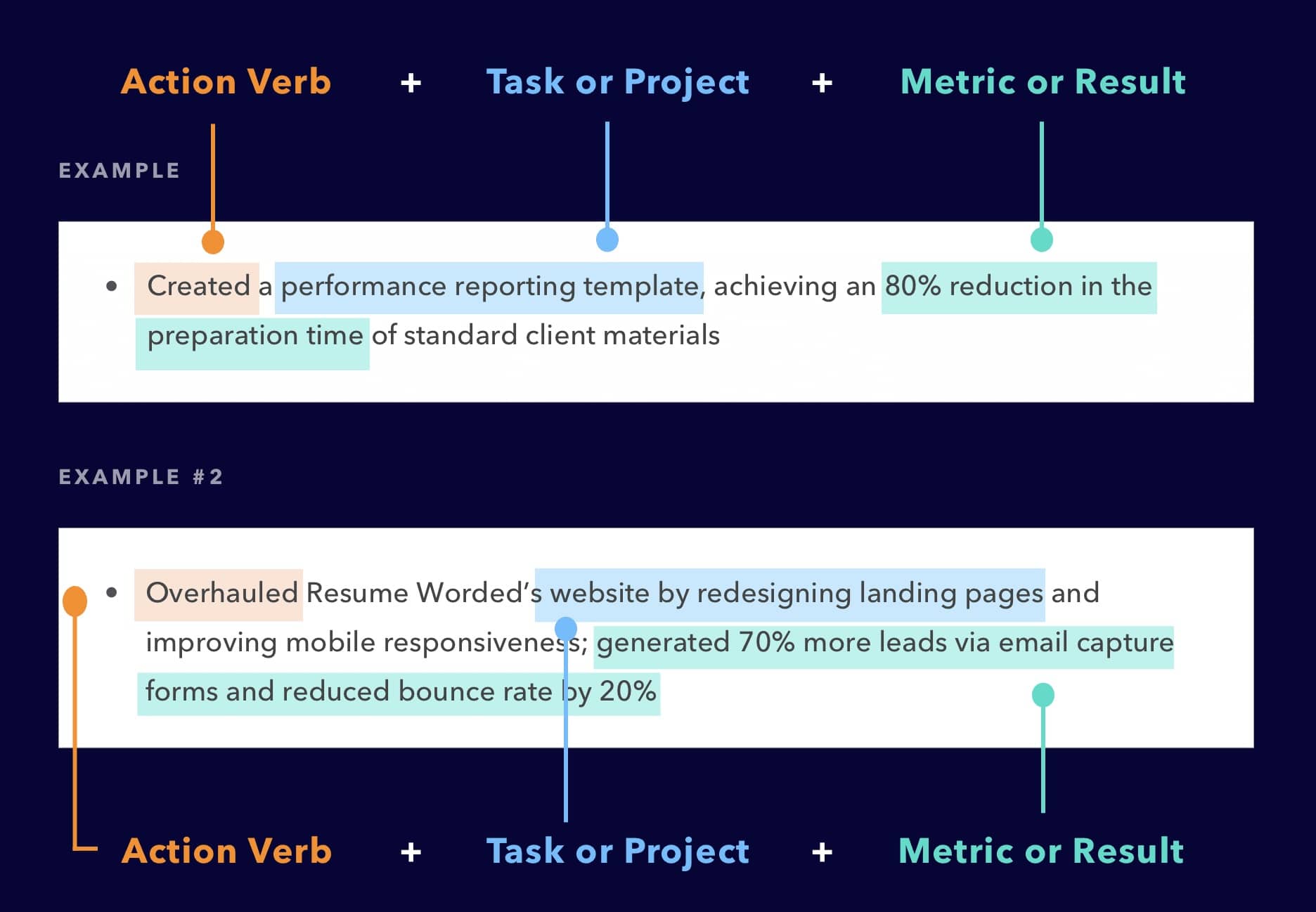
Here is the second pattern. You again start with an action verb, then state your impact, and finish by briefly describing the task, project, or how you did it. In this example, fewer support calls was the result.
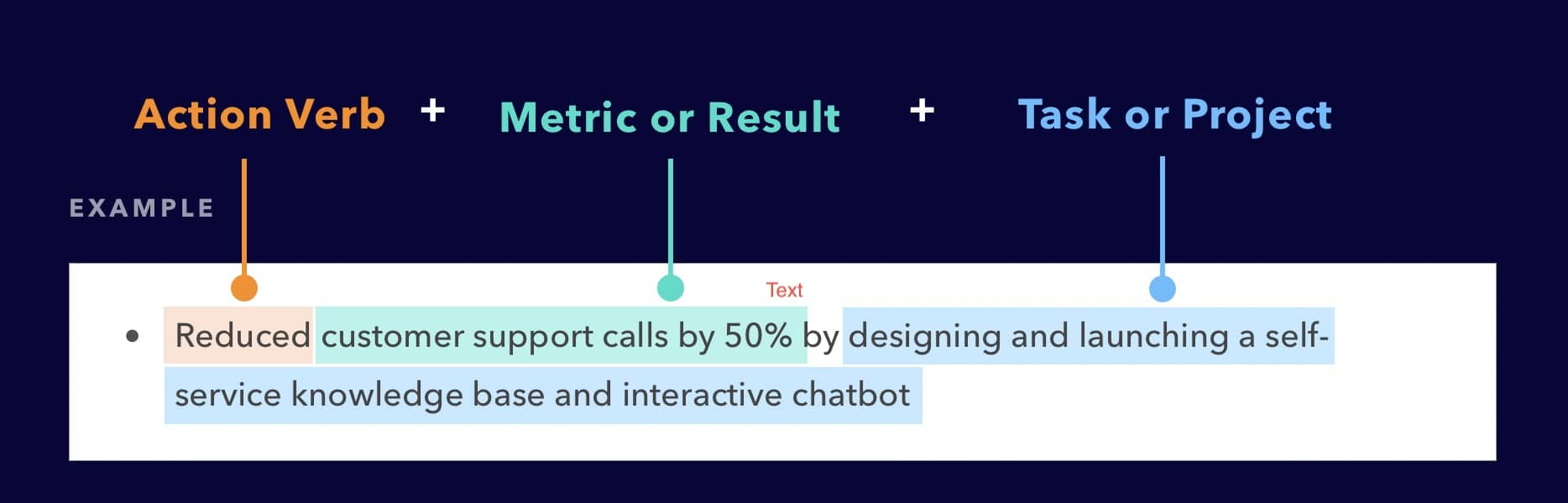
Below you can see a full list of action verbs that work well in a resume.
Full list of action verbs
Strong Accomplishment-Driven Verbs
Use these action verbs in your resume to describe your achievements in a more powerful way.
Communication Skills
Use these verbs to describe your communication skills.
Entrepreneurial Skills
As an entrepreneur, you need to be able to wear many hats. Use these action verbs in your resume to describe your entrepreneurial skills.
Management Skills
Managers need to be able to lead and motivate their team. Use these verbs to describe your management skills.
Leadership, Mentorship and Teaching Skills
Use these action verbs in your resume or CV to show that you are a leader, mentor or teacher.
Research and Analysis Skills
Use these action verbs in your resume to describe your research and analysis skills.
Problem-Solving Skills
Use these action verbs in your resume to show that you are a problem solver.
Process Improvement, Consulting and Operations Skills
List of the most powerful action verbs to use in your resume or CV to describe your process improvement, consulting and operations skills.
Financial Skills
In finance, you need to be able to manage money and make decisions. Use these action verbs in your resume to describe your financial skills.
Design and Creative Skills
Are you a designer or creative professional? Use these action verbs in your resume to show off your design and creative skills.
Clerical or Detail-Oriented Skills
Wow your future employer with your attention to detail by using these action verbs in your resume to describe your clerical or detail-oriented skills.
Engineering and Technical Skills
As an engineer, you need to be able to solve complex problems. Use these action verbs in your resume to describe your engineering and technical skills.
This section's checklist
0/1How to write the skills section on your resume
A required part of every resume is your skills. This is where you list all the skills you have to show why you are a good fit for the role. Broadly, skills fall into two categories, and a strong resume covers both.
Hard skills
A hard skill is measurable. It can be anything from a programming language like TypeScript, to a library like React, to even knowing how to cook a great stew.
A hard skill usually refers to technical knowledge or training that you have practiced and acquired. For a given job, a hard skill is specific and essential so that you can meet the demands of that role. As an example, the items below are hard skills depending on the job.
Examples of hard skills
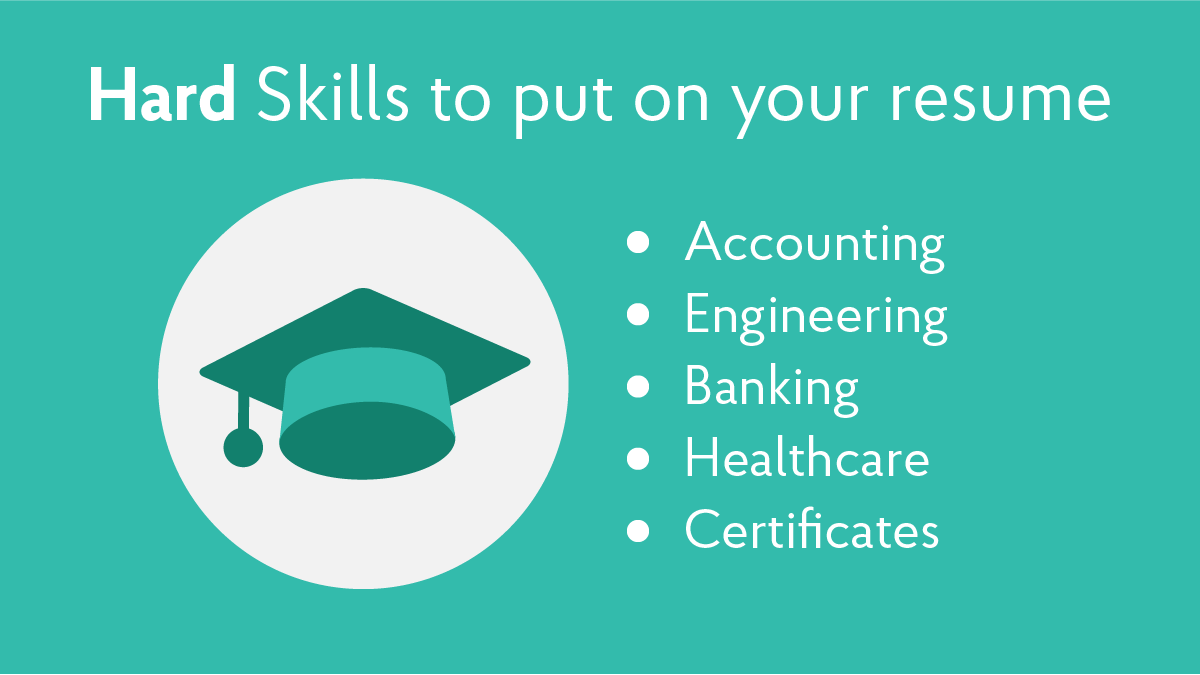
Machinery skills - operating a road roller, operating a POS, pallet-stacker, forklift, etc.Software skills - Adobe Creative Suite, Ableton Live SuiteTools - SEM Marketing, Stethoscope, Google Analytics, Google Search Console, ERP systems, CRMsCoding languages - JavaScript, TypeScript, Python, C++, C#, Java, Scala, RTechniques - Frequency analysis, CrystallizationMathematicsAccounting & bookkeepingSoft skills
These are personal skills that can be a mix of social skills, communication skills, personal traits and qualities, work-related attributes, and so on. For example, you can mention skills like leadership, critical thinking, management, and communication. Soft skills are usually not spelled out in the job description, but they can indirectly show that you will fit in with the work environment and the company culture.
Effective communication, Teamwork, Responsibility, Creativity, Problem-solving, Leadership, Extroversion, People skills, Openness, AdaptabilityTailor your skills to the job posting you have in mind
You might have excellent, rare skills, but that is not always useful. For example, imagine you know accounting, but what exactly does a developer need accounting for?
The most important point is to follow the job postings you are interested in, find the keywords in them, and if you have those skills, mention them on your resume.
This is valuable because by checking job postings you can see which way the market is heading and which skills it needs, then grow in that direction.
Do not forget general skills
Some skills suit a wide range of jobs: some soft skills like teamwork, critical thinking, and leadership, and some hard skills like Excel, PowerPoint, Photoshop, writing, and so on.
For any job you apply to, you can comfortably mention these skills because they may help you in some way.
For example, a recruiter looking for a software engineer does not care about your marketing skills. At the same time, your skill level in a programming language will definitely matter to them.
ATS works based on keywords, and your resume needs to contain enough of those keywords. If there was no chance to mention them elsewhere, you can point to them here.
For example, imagine there is a job posting for Java and your resume does not mention the word Java at all. You can be sure this resume gets rejected by the ATS. In fact, 70 percent of resumes are filtered out at this very stage and never reach the next step, which is the human review.
Even if a company does not use an ATS and the review is done by human resources, keep in mind that they were told to look for a set of keywords in the resume and, if present, send it forward for an interview. So whether it is for the ATS or the HR manager, write the skills that fit the job posting on your resume.
In some jobs, soft skills matter more than hard skills. These days, plenty of organizations would rather hire for character than for skill.
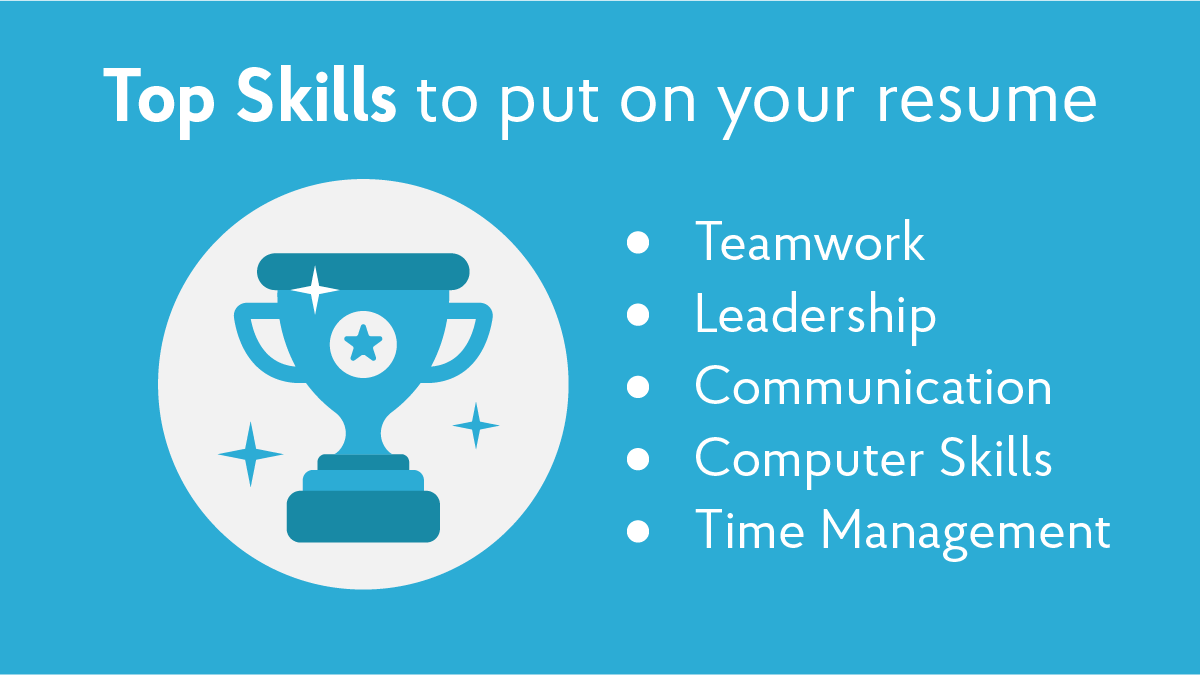
Infographic: which skills should we put on a resume?

Most requested soft skills across industries
Time management, Effective communication, Emotional intelligence, Conflict management, Teamwork skills, Stress management, Productivity & organization, Critical thinking, Attention to detail, AdaptabilityResearch the market before you finalize your skills
Most job titles share a common core of required skills. Missing those skills has a real negative impact on your CV. So find them and make sure they are on your resume.
- Go to LinkedIn and search for the job title you want to apply for.
- Open 10 or more real job posts for that title, on LinkedIn or other job sites.
- Note the skills those posts ask for again and again.
- For every skill you already have, make sure it is written on your resume.
- For every required skill that is missing from your resume, add it.
- If you do not even know what a required skill is, go learn it. Spend the time and genuinely improve.
- Make sure the shared core skills that most of these posts want are all present on your resume.
Skills by industry
Marketing skills
Data analysis, Web analytics, SEO/SEM, HTML & CSS, WordPress, Email marketing, Web scraping, CRO and A/B Testing, Data visualization & pattern-finding through critical thinking, Search Engine and Keyword Optimization, Project/campaign management, Social media and mobile marketing, Paid social media advertisements, B2B Marketing, The 4 Ps of Marketing, Consumer Behavior Drivers, Brand management, Creativity, Copywriting, Storytelling, Sales, CMS ToolsManagement skills
Six Sigma techniques, The McKinsey 7-S Framework, Porter's Five Forces, PESTEL, Emotional Intelligence, Dealing with work-related stress, Motivation, Task delegation, Technological savviness, People management, Business Development, Strategic Management, Negotiation, Planning, Proposal writing, Problem-solving, Innovation, CharismaSales skills
Customer Relationship Management (CRM), Cold-calling, Negotiation, Public speaking, Closing, Lead generation, Buyer-Responsive selling, Buyer engagement, Product knowledge, Persuasion, Effective communication and sociability, Empathy, Social media/digital communication, Teamwork, Time managementDesign skills
Adobe Creative Suite: Illustrator, InDesign, Photoshop, Dreamweaver, Infographics, HTML & CSS, Photo editing, Typography: spacing, line height, layout, choosing fonts, Storyboarding, Targeting and marketing through visual communications, Logo creation, Digital printing, Integration of visual communication in social media platforms, Creativity, Attention to detail & aesthetics, Interactive media design, Color sense & theory, Ad design, Active listeningBasic technical skills
Microsoft Office Pack: Word, Excel, Access, Publisher, Outlook, PowerPoint, Filing and paper management, Data entry, Bookkeeping through Excel or TurboTax, Research and data analysis, Basic knowledge of user interface communication, Technical writing, Cloud networking and file sharingAccounting and finance skills
Microsoft Excel (Advanced), Enterprise Resource Planning, Big Data Analysis & SQL, Know Your Customer (KYC), Cognos Analytics (IBM), Visual Basic, Accounting Software, Revenue recognition, Anti-Money Laundering, Clear communication, General business knowledge, Numerical competence, Accuracy, Attention to detailTeaching skills
Updated curriculum knowledge, Research & Data analysis, Communication, Educational platforms (software like Elearn), Stress management, Technological & digital literacy, Patience, Critical thinking, Enthusiasm, MotivationWeb design skills
HTML/CSS, CSS preprocessors, JavaScript, WordPress, Graphical User Interfaces (GUI), Git/Version control (GitHub, GitLab), Search Engine Optimization (SEO), Application Programming Interface (API), Adobe Photoshop, InDesign, Content Management Systems (CMS), Testing/Debugging, Responsive design principlesBusiness analysis skills
SQL (a must) and Hive (optional), Programming language (R, Python, Scala, MATLAB), STATA, SPSS, SAS, Data Mapping, Entity Relationship Diagrams, Wireframes, Big Data tools, Microsoft Visio, Agile Business Analysis, Machine learning, System Context Diagrams, Business Process Modeling, Technical and non-technical communicationNursing and healthcare skills
Mathematics, CPR, Patient care and assistance, Paperwork/record-keeping abilities, Compassion, Advanced Cardiac Life Support (ACLS), Telemetry, Attention to detail, Physical endurance, Acute care, Infection control, Surgery preparationThis section's checklist
0/1The education section in your resume
This is probably a simple section, but depending on your situation it may need a bit of finesse.
It is best to first list everything you might include, then move on to the tricks that help you stand out.
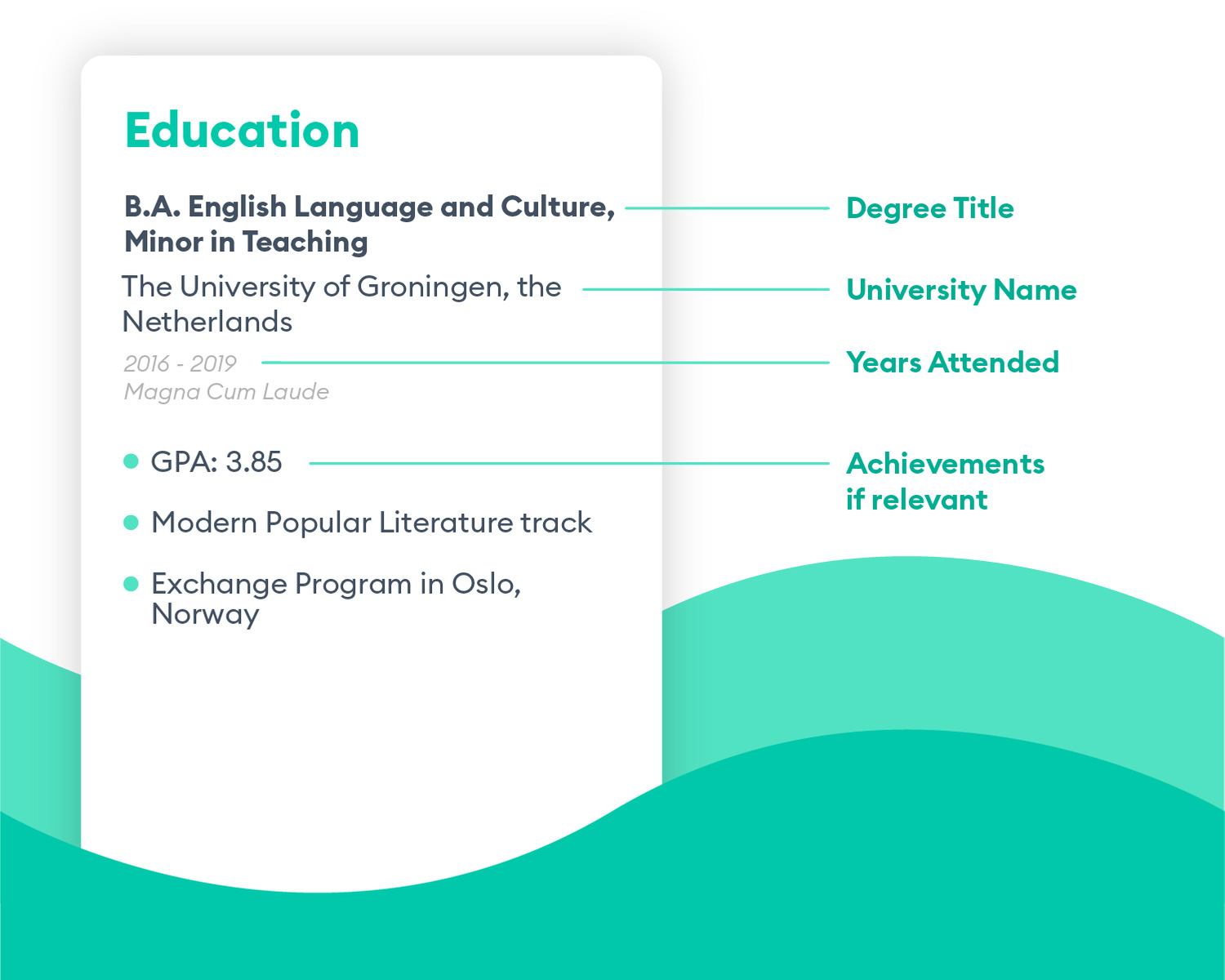
The degree title
B.S. in Computer Software EngineeringThe name of the university or institution
Azad UniversityYears attended, graduation year, or expected completion
2008 to 2012If your studies took longer than usual, or you would rather not share the details, you can list just the graduation year. For example:
2014When you have not graduated yet and expect to finish by a certain time, for example:
Expected in 2025Optional information about your education
The one exception is early on. When you have little work experience, these items can help fill the page. Even then, make sure each one adds real value. If your GPA was not strong, why mention it?
GPA
On an academic CV, mention it only if you were a strong student with a GPA above 3.5. On a work resume, skip it.
GPA: 3.9University location
London, UKHonors
One of the top students in the classAcademic achievements
Published a research paper in the university journalRelevant courses you passed
Do not list the courses you passed on a work resume. They belong on an academic CV, or on your first resume when you need to fill space.
Software Engineering, Database Management, AlgorithmsExchange program for a doctorate
Exchange Program in Oslo, NorwayA few tips about the education section
- Always put your most recent degree at the top and work backwards in order.
- If you have a university degree, there is no need to mention your high school diploma or pre-university certificate.
- If you have just graduated and have no work experience, you can place the education section at the top of your resume.
This section's checklist
0/1Optional sections on a resume
The sections we covered earlier were all essential. If you got them right, rest assured you will land any job you apply for. Still, the sections below can help you build a richer resume.
The important thing to keep in mind is that you have six seconds. So if a section is worth it, add it to your resume, and if it is not, skip it.
Languages
A languages section usually adds no value. Your CV is already written in a language, so they assume you speak it. An English CV means you speak English. A German CV means you speak German.
Listing your native language adds nothing. Persian on an English CV tells them what they already assumed. Nobody is impressed by your mother tongue.
So if the only thing you would list is your native language, remove the languages section entirely. Only list a language when it genuinely adds value for the role, a real additional working language. If a job wants German and you speak it, that belongs here. That is when the section earns its space.
For the languages section, simply name the language and write your level in it next to the name.
In order: native language, fluent, proficient enough to work in a professional setting, intermediate, and basic.
- Native
- Fluent
- Proficient
- Intermediate
- Basic
Keep in mind that you should never lie about your language skills. You never know; your interviewer might be fluent in that language or even a native speaker!
Volunteer experience
If you are the kind of person who helps others in your free time without expecting anything in return, there is a good chance you are the kind of employee for whom some things matter more than money. It can create the impression that you are likely a dedicated and loyal employee.
Several studies have shown that adding a volunteer experience section improves your chances of getting hired. Especially when you are a student with no experience yet, volunteer work can give you a real boost.
Hobbies and interests
A little spice? This section may not be the most important one, but it can still help you show a bit of your personality. Maybe the recruiter shares a hobby with you and warms to you because of it. If you still have empty space on your resume, it is worth filling it with this section.

Certifications and awards
Do you have an award that sets you apart in your field? Or a certification that proves your expertise? If it is relevant to the job you are applying for, you can add it to your resume.
For example, imagine you are a cloud specialist. Holding certifications like Azure Solutions Architect Expert can back up your skills.
Publications
Do you sometimes write for websites and magazines? Or do you have notable academic work, such as an ISI paper?
If you have work published online or in a relevant academic journal, you may want to add it to your resume. Just remember to include a link to the work so the recruiter can do a quick check.
Publications mainly help early in your career, or to fill space when you have little experience. Once you have a few years behind you and grow more senior, your achievements at work matter far more than your publications.
Projects
Working on relevant side projects can show your passion for your work. For example, a university class project, a part-time entrepreneurial venture, taking part in a university competition, or even making handmade products and selling them. Hiring managers love to see that their employees do interesting things in their free time.
A projects section is mostly for entry-level people, roughly 1 to 2 years of experience. If you already work somewhere, your achievements at that job are more interesting than any side project. A very large side project built while you work full time can even read as a red flag. How did you have the time?
Open source contributions are different. They are always appreciated. You normally do them in your free time, and they show genuine engagement with your craft.
This section's checklist
0/2How many pages should a resume be?
- If you have under 10 years of experience, one page is definitely enough
- For more than 10 years of experience, keeping it to one page is strongly encouraged
- For more than 15 years of experience, still aim for one page. If that is not possible, two pages, but no more than that
Think about it. When something is not going to be read, why should it be there at all?
Remember that a resume is different from a CV. A CV can be two to three pages, and in special cases even up to eight pages. If you want to apply for a job, you need a resume, not a CV. A CV is usually used for academic purposes.
How do I fit my resume on one page?
When you are just starting out, you try to put everything on your resume and it still might not fill a page, because you do not have much experience yet. But once you have more experience and more years of work behind you, simplifying gets complicated.
Let us go through a few techniques together that can get your resume down to one page.
Focus on relevant information
Always remember that only the relevant information mentioned in the job posting, the things the employer is looking for, matters. For example, if you are applying as a software engineer, your internship experience as a social media manager does not matter at all. The employer does not need to know that you enjoy yoga, especially if you are short on space.
Achievements instead of responsibilities
Listing responsibilities is pointless. It makes the resume longer, it tires the employer out from reading, and it does nothing to set you apart. Just from reading your job title, they can roughly tell what your responsibilities were. Instead, focus on the concrete metrics that were your achievements.
Instead of describing your work experience in paragraphs, break it into items and use bullet points, meaning put a dot next to each one. Also try to keep your sentences short and to the point.
Customize the margins
You can always create extra empty space by reducing the page margins. Instead of 2.5 cm, you can use a 1 cm margin to gain a lot of empty space. The spacing between experience items or bullet points, the spacing between sections, and the line height can all be reduced to add to your space.
Smaller font
Font size 12 is standard for regular text, but that does not mean you have to follow it on your resume. You can try 11 or 11.5 to add a lot of empty space. Just make sure no one needs to zoom in to read your resume.
Remove unnecessary header space
Contact details or the resume summary sometimes take up a lot of space because of the design. Optimize the header space.
Remove your school education
Unless your employer went to the same school, once you have a university degree there is no need to list your high school diploma and pre-university studies.
Remove repetitive entries
If you had similar responsibilities at several companies, do not repeat the job description. It is really not interesting for an employer to see the same phrase several times.
Keep the resume summary summarized
The name says it all. It should be brief. You should not write 6 lines and add 10 bullet points. Try to wrap it up in 3 lines at most.
Use resume builder sites
Changing the design of your resume yourself might be hard. Sites built for creating resumes have plenty of ready-made one-page templates, and you just need to enter your content and it fits everything on one page for you.
This section's checklist
0/2ATS, the Applicant Tracking System
There is a giant called the ATS, and once you learn its tricks you can get past it and let a real person read your resume.
ATS stands for Applicant Tracking System. It is an automated system that checks your resume against the job when you submit it, to decide whether you are a fit or not. When you are not a fit, you usually get a rejection email without anyone ever reading your resume, and those emails tend to look alike.
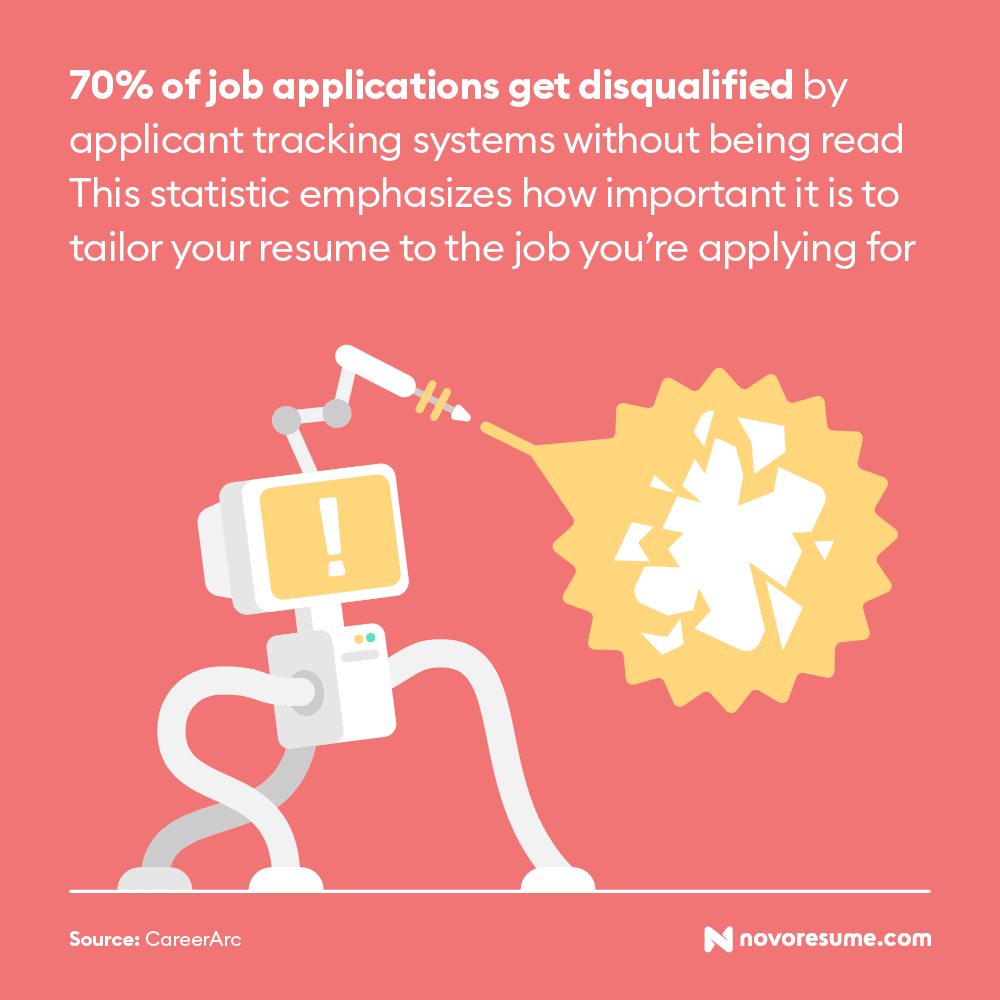
The ATS is a kind of robot that filters hundreds of resumes and passes only the better matches on to human resources and the recruiters.
You are probably surprised. You may be telling yourself, if a robot is going to say no to me, why spend all this time getting my resume right? :(
Do not worry. Once you know what you are dealing with and how it works, getting past it will not be hard. The key is to read the job posting and tailor your resume to it. To do that, you need to find the keywords and use them in your own resume.
Let us take a simple example. We will read a posting for a digital marketer and see what matters to the company.
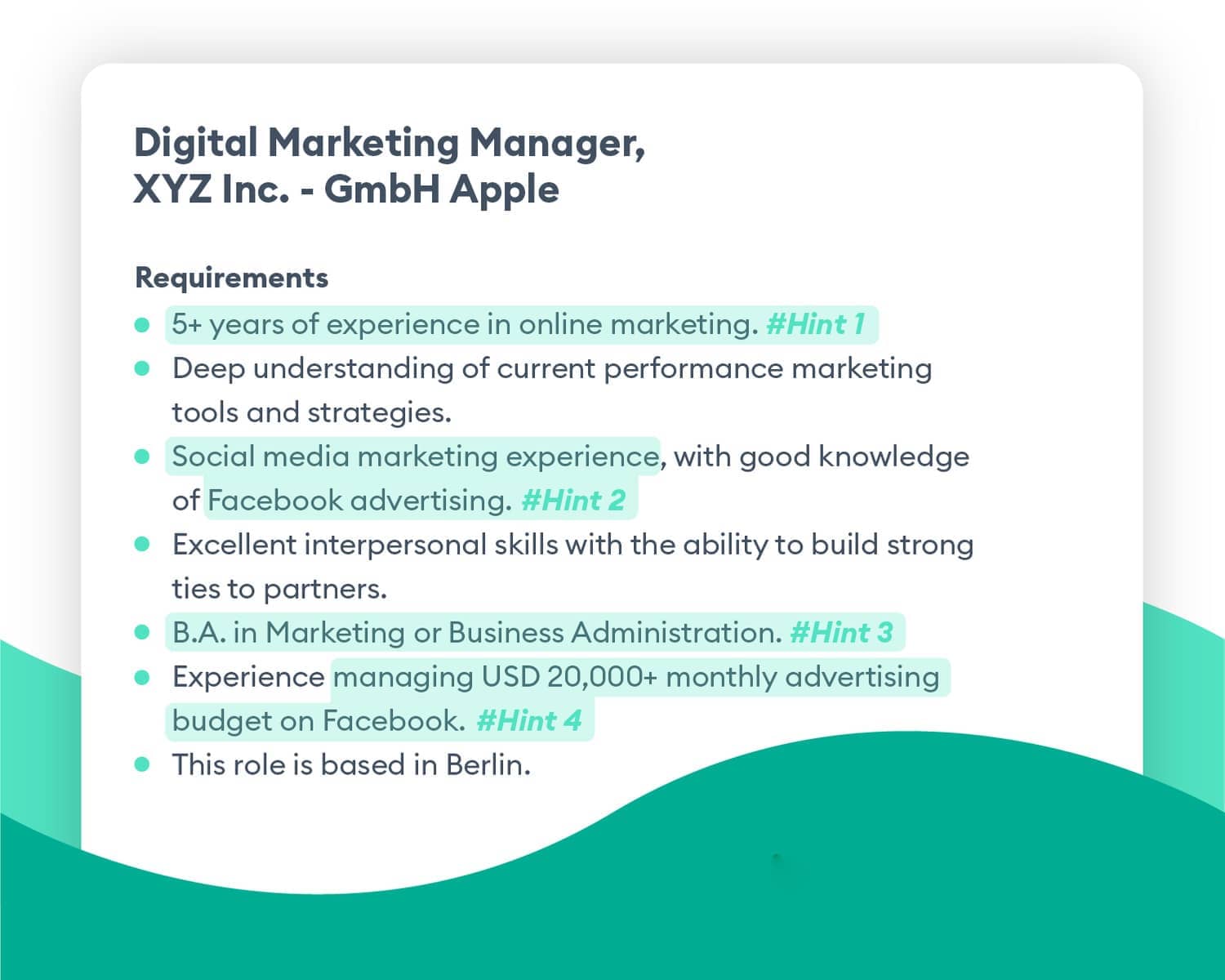
5+ years of experience in online marketingSocial media marketing experience ... Facebook advertisingB.A. in Marketing or Business Administrationmanaging USD 20,000+ monthly advertising budget on FacebookNow, to tailor your resume to these requirements, all you need to do is add these points to your own resume. Of course, I mean something like them, based on the achievements and qualifications you actually have.
This section's checklist
0/1Free resume writing checklist
So, are you done? I think it is time to go through the list below to make sure you have applied every tip that was mentioned in your own resume.

See the full checklist
Score your resume
Want a number on where you stand? Grade your resume section by section, get the fix for each issue, and share the result as one link.
The score just helps you picture where you stand. Above 70 is good, and every item is a suggestion, not a rule.
References
This article draws on a range of sources and combines them with extra notes of my own. You can see the full list below and read the originals if you like. That said, I have tried hard not to leave anything out.
Full list of references
- https://novoresume.com/career-blog/how-to-write-a-resume-guide
- https://novoresume.com/career-blog/how-long-should-a-resume-be
- https://novoresume.com/career-blog/job-titles-on-resume
- https://novoresume.com/career-blog/resume-fonts
- https://novoresume.com/career-blog/contact-information-on-resume
- https://novoresume.com/career-blog/what-to-put-on-a-resume
- https://novoresume.com/career-blog/most-important-skills-to-put-on-your-resume
- https://novoresume.com/career-blog/optimize-linkedin-profile-to-complement-your-resume
- https://novoresume.com/career-blog/how-to-list-work-experience-on-a-resume
- https://novoresume.com/career-blog/how-to-list-education-on-a-resume
- https://novoresume.com/career-blog/resume-summary
- https://novoresume.com/career-blog/ats-resume
- https://resumelab.com/resume/how-to
- https://resumelab.com/resume/format
- https://zety.com/blog/how-to-make-a-resume
- https://business.time.com/2012/04/13/how-to-make-your-resume-last-longer-than-6-seconds/
- https://www.youtube.com/watch?v=Gt2AQG-u8xM
- https://www.youtube.com/watch?v=HfEvIuUvF2Q
If you have a tip to add or think a part needs fixing, I would be glad if you sent it over so I can update this and keep it a complete reference for writing a resume.
Write your resume with AI
Using ChatGPT, Claude, or any AI to write your resume? Point it at this guide so it follows a proven method instead of generic filler. I turned this whole guide into two files any AI can read, both built from the same checklist you just used.
- /resume/llms.txt: the full method as weighted rules an AI can follow and score against.
- /resume/skill.md: a ready-made skill you can hand to Claude or drop into your own AI tool.
Or paste this prompt into your AI and add your resume plus the job posting:
Act as a resume expert and follow the MrAdib method at https://mradib.com/resume/llms.txt. Review my resume section by section, rewrite each experience bullet as an achievement with a number, open every bullet with a strong and varied action verb, tailor the wording and keywords to the job posting I paste, then score the result out of 100 and list the fixes in order of impact.
Raising money next? The same method covers the whole fundraising kit, from the pitch deck to the application.
Cover Letter
Writing your resume is the first step. The next is a cover letter, a short letter that shows the hiring manager your motivation for the role, so that together with your resume it earns you an interview.
A full guide on writing a cover letter is coming soon.